

General
Types of Air Plants Worth Growing in South Florida
Discover the most popular types of air plants, how to care for them in South Florida's humidity, and which species work best indoors and as gifts.
By Daniel Sanchez, CEO · Published 2026-10-10
Air plants are genuinely low-maintenance, and that's not just marketing language. They grow without soil, pull moisture from the air, and adapt well to the kind of bright, humid conditions South Florida delivers almost year-round. If you're trying to figure out which ones to buy, display, or give as a gift, the variety matters more than most people realize. Different types of air plants have distinct shapes, bloom colors, and care requirements, and choosing the right one for the light and humidity you actually have will save you a lot of frustration.
Here's a practical look at the most useful species, how to tell them apart, and where they fit in a home or arrangement.
The Main Types of Air Plants and What Sets Them Apart
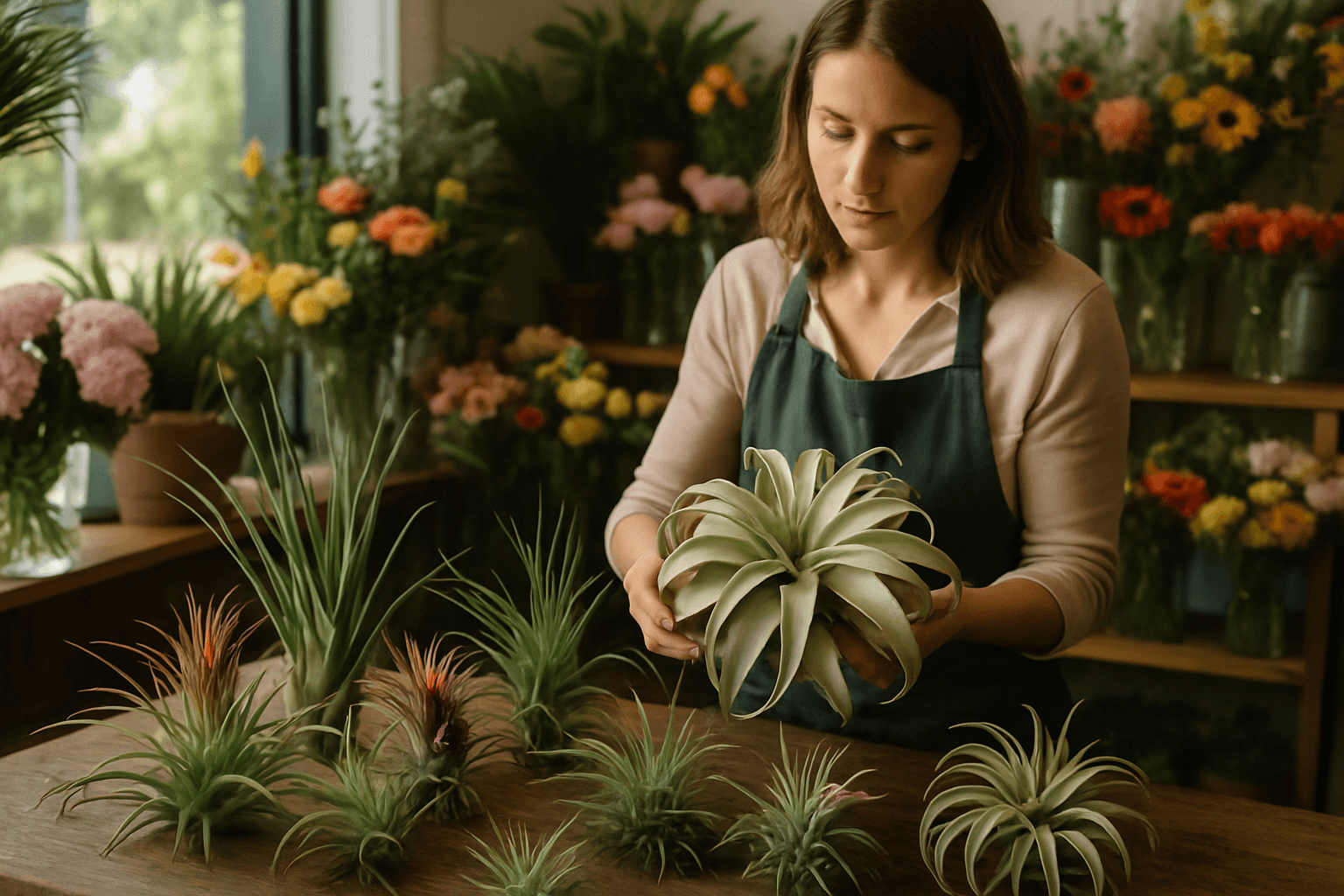
Tillandsia is the genus that covers what most people call air plants. There are hundreds of species, but a manageable handful show up consistently in shops, arrangements, and home décor. The differences between them come down to leaf texture (smooth and glossy versus fuzzy and silvery), size, moisture needs, and bloom behavior.
A rough but useful dividing line: air plants with smooth, green leaves generally prefer more water and indirect light, while those covered in silvery-grey trichomes (the tiny hair-like scales you can see and feel) are adapted to drier conditions and handle more direct sun. South Florida's outdoor humidity often does part of the watering work for the silvery types, but the green-leafed varieties need more deliberate attention indoors with air conditioning running.
Tillandsia ionantha: The One Most People Start With
T. ionantha is small, forgiving, and widely available. It tops out around two to three inches, making it easy to tuck into a terrarium, mount on driftwood, or nestle into a floral arrangement. When it's about to bloom, the inner leaves flush from green to red or pink, and it produces small violet flowers. After flowering, it produces offsets (called pups) that can be separated once they reach about a third of the parent's size.
For South Florida conditions, T. ionantha does well on a covered lanai or near a bright window. Mist it two or three times a week during dry months, or soak it for about 20 minutes once a week and shake off the excess water before setting it back in place. Water sitting in the base of the leaves will rot them.
Tillandsia xerographica: Statement Plant, Minimal Fuss
T. xerographica is the one that makes people stop and ask what it is. It grows as a wide, sculptural rosette with thick, silvery-grey leaves that curl at the tips. Mature specimens can reach eight to twelve inches across. The trichomes are dense, which means it handles drier air and bright light better than most species.
It blooms slowly, sending up a tall spike with pink and purple flowers, and the process can take several months. Don't rush it. In the meantime, the plant itself is the display. It works well in a bowl on a table, on a piece of coral rock, or as a focal point in a mixed arrangement with orchids or tropical foliage.
Water xerographica less frequently than the smaller, greener types. A weekly soak of about 30 minutes, followed by drying upside down so water doesn't pool in the rosette, is the standard approach. In South Florida's outdoor humidity during October, you can often scale back to every ten days.
Tillandsia caput-medusae: The Odd One
The name comes from the wild, tentacle-like leaves that curl outward from a bulbous base. T. caput-medusae has a hollowed base that can trap water easily, so it needs to dry quickly after watering. Don't mount it in a way that holds it upright with the base cupped; a slight angle or an inverted mount works better.
Bloom color is typically red to orange with purple flowers, and the plant is hardy enough to tolerate the occasional missed watering. It's a good option for someone who wants something visually interesting but doesn't have a precise watering routine.
Tillandsia usneoides: Spanish Moss, the Native One
Most people don't think of Spanish moss as an air plant, but it is. T. usneoides grows wild across South Florida, hanging from live oaks and cypress trees in long, silvery curtains. It has no leaves in the traditional sense, just tiny filaments covered in trichomes that absorb water and nutrients from rain and the air.
As a display plant, it's useful for draping over branches, hanging in loose cascades, or layering into larger floral and botanical arrangements. It needs good airflow to stay healthy; it'll rot in a sealed container. Mist it regularly or let South Florida's outdoor humidity handle it on a screened porch.
It also happens to be one of the most underused plants in local arrangements. If you're building something with a natural, coastal feel, a handful of Spanish moss adds texture without competing with the blooms around it.
Tillandsia stricta: Easy to Bloom, Easy to Find
T. stricta is a reliable bloomer, which makes it popular. It produces a bright pink or red bract (the paddle-shaped structure that holds the flowers) and small blue or purple flowers. The plant itself stays compact, usually three to five inches, with stiff, narrow leaves that fan out from the center.
It tolerates a wide range of humidity levels, which suits South Florida's variation between outdoor conditions and heavily air-conditioned interiors. Soak it weekly, dry it thoroughly, and give it bright indirect light. It offsets freely, so one plant becomes a cluster over time.
Air Plants as Gifts: What to Know Before You Buy
An air plant makes a practical housewarming gift because it doesn't need a pot, doesn't drop leaves, and won't die if someone forgets it for a week. The tricky part is matching the plant to the recipient's actual living conditions. A xerographica for someone with a bright, sunny home is a good call. A stricta or ionantha for someone in a darker apartment is safer.
If you want to give something with more presence than a single plant but don't want to hand over a full bouquet, an arrangement that combines air plants with tropical foliage or locally grown orchids can be a strong option. The Adoration arrangement is worth looking at for that kind of occasion.
For other gift ideas by occasion, the housewarming gifts and congratulations categories both have options that pair well with a potted or mounted air plant.

Adoration
$399.95
Displaying Air Plants at Home
Mounted displays work better than containers for most species, because airflow around the entire plant matters. Cork bark, driftwood, and shell pieces are all common mounting surfaces in South Florida homes, and they suit the coastal aesthetic well.
Glass globes look appealing but need to be open-ended, not sealed. A globe with an opening at the top or side gives the plant the airflow it needs while keeping the visual effect.
For tabletop displays, xerographica works in a shallow bowl. Smaller species like ionantha and stricta look good in groups of three or five on a tray or piece of wood, mixed by size and texture.
The one thing to avoid: don't place any air plant directly under an air conditioning vent. The dry, cold air will pull moisture out of the leaves faster than the plant can recover, even if you're watering regularly.
Getting the Most Out of South Florida's Climate
South Florida's outdoor humidity in October sits high enough that many air plants need very little supplemental watering on a screened lanai or in a partially shaded outdoor space. The challenge shifts indoors, where air conditioning reduces humidity significantly.
If you keep air plants inside year-round, a humidity tray near the plants or a small room humidifier helps. Grouping plants together also raises the local humidity slightly. For placement near a window, filtered light through a sheer curtain is preferable to direct afternoon sun, which can scorch the leaves.
UF/IFAS Florida Flowers covers general growing conditions for Florida plants and is worth bookmarking if you're expanding a collection beyond air plants.
Putting It Together
The types of air plants most worth your attention are T. ionantha, T. xerographica, T. stricta, T. caput-medusae, and T. usneoides. Each has a distinct profile, and knowing roughly what you're working with makes care straightforward rather than guesswork.
If you're looking to pair an air plant with cut flowers or a more traditional arrangement for a gift, the Boca Raton Florist shop has options across a range of occasions. The all flowers section is a good place to browse if you're not sure where to start. Same-day orders placed before 3:00 PM local time are available for most arrangements.