

General
What the Sunflower Life Cycle Tells You About Growing Them
Follow the sunflower life cycle from seed to dried head, with practical tips on timing, care, and cutting that apply to South Florida's warm climate.
Por Daniel Sanchez, CEO · Publicado el 2026-10-06
The sunflower life cycle is one of the most legible in the plant world. Each stage is distinct enough that you can see exactly where you are, which makes sunflowers forgiving teachers whether you're growing a backyard row or sourcing stems for arrangements. Understanding the sequence also helps you time a harvest correctly, keep cut sunflowers fresher, and know what to expect if you're planting them in South Florida's warm, year-round growing conditions.
Here's a stage-by-stage look at how a sunflower moves from seed to spent head, with notes on what each phase means for home growers and flower buyers alike.
Stage One: The Seed
A sunflower seed is already a complete blueprint. Each one contains the embryo, the food reserve it needs to germinate, and a tough outer coat that protects it until conditions are right.
Germination typically takes seven to ten days when soil temperature stays above 50°F. In South Florida, that threshold is rarely a limiting factor. The more relevant concern here is moisture: too little and the seed coat doesn't soften, too much and the embryo rots before the root tip can push out. Consistent, moderate moisture is what you're aiming for in the first week or two.
The radicle (the first root) emerges downward before the shoot pushes up. That root anchors the seedling before it's visible above the soil, which is worth knowing because the plant is doing real work underground before you see any sign of it.
Stage Two: Seedling
Once the shoot breaks the surface, the cotyledons (seed leaves) open and start gathering light. These aren't the true leaves; they're a temporary food bridge that sustains the plant until photosynthesis takes over. They look rounded and plain compared to what comes later.
At this point the seedling is at its most vulnerable. It can be knocked back by heavy rain, eaten by slugs, or stressed by transplanting. Direct sowing tends to produce stronger seedlings than transplanting in most cases, because the taproot grows undisturbed. If you're growing in South Florida's sandy soil, mixing in some organic matter helps water retention without waterlogging.
The seedling stage lasts roughly two to three weeks before the first true leaves arrive.
Stage Three: Vegetative Growth
This is the long middle stretch, and it moves faster than most people expect. True leaves appear in pairs, the stem thickens, and the plant puts on serious height. Standard sunflower varieties grown for cut flowers can reach five to seven feet; dwarf varieties stay under two. Branching cultivars like 'Lemon Queen' send out multiple stems, while single-stem types like 'Procut Orange' put everything into one large head.
Sunflowers are heliotropic during this stage: young stems track the sun from east to west through the day, then reset overnight. This movement slows once the flower head opens and the plant becomes more fixed in orientation.
South Florida's heat speeds up vegetative growth. A plant that might take 60 days to reach bud stage in a cooler climate can get there in 45 to 50 days here. That's useful if you're planning for a specific occasion but it also means missing the right harvest window is easier to do.
Understanding the Sunflower Life Cycle at the Bud Stage
The bud is the pivot point of the whole process. It forms at the top of the main stem, initially enclosed in green bracts, and then swells over several days before the first ray petals pull back to reveal the disc florets at the center.
The disc florets are what most people think of as the center of the sunflower, but each one is actually a separate small flower. They open in rings from the outside toward the center over ten to fourteen days. That progression matters for cut flower timing: a head where the outer disc florets are just beginning to open will hold much longer in a vase than one that's fully open at harvest.
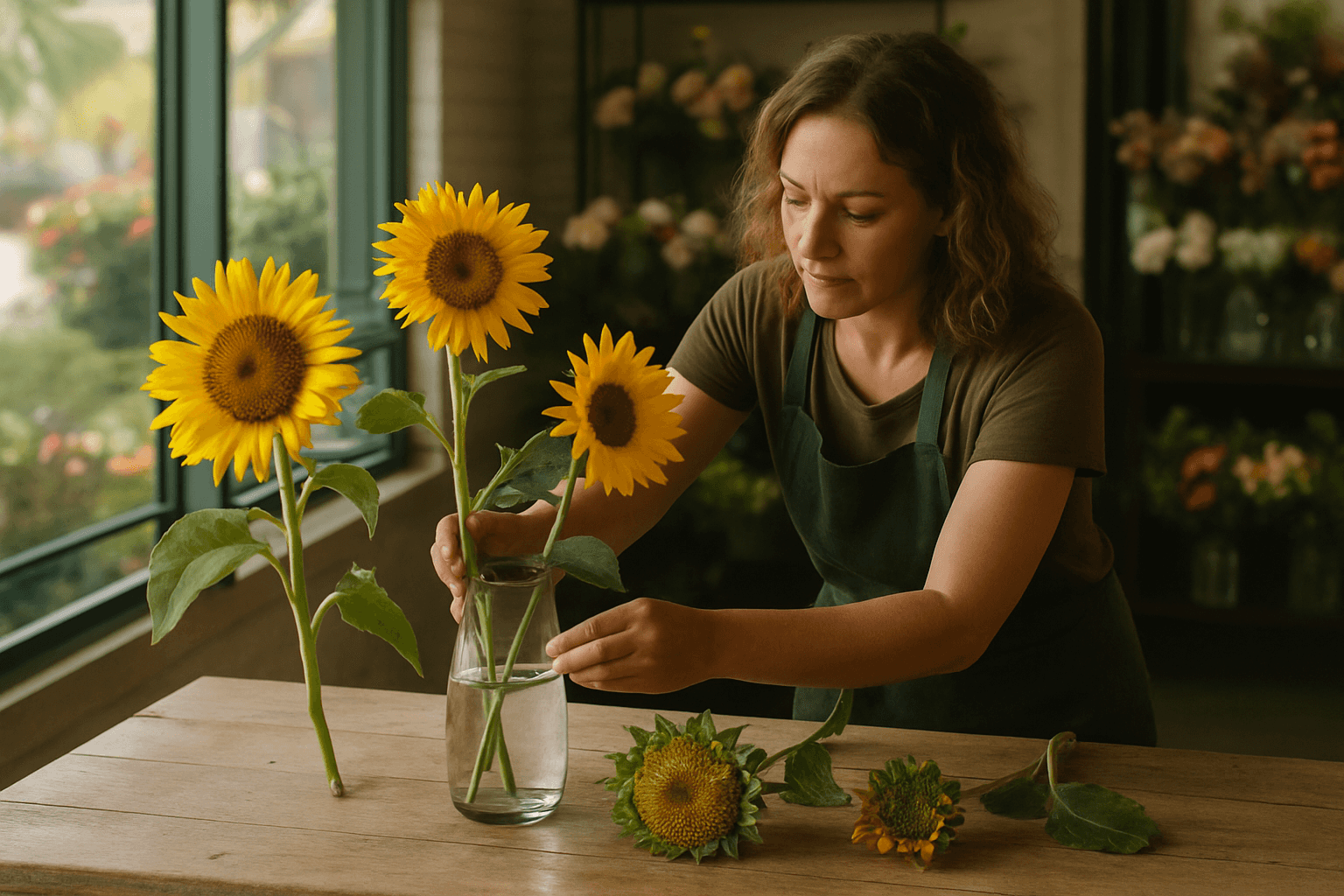
If you're cutting for arrangements, harvest when the petals are fully extended but the center disc still looks tight. A sunflower cut at that stage can last seven to twelve days in a clean vase with fresh water, which compares well with most other large cut flowers.
Stage Four: Flowering and Pollination
Once the ray petals open fully, the flower is in its peak display window. In a garden setting this is also when pollinators arrive in numbers: bees especially work the disc florets systematically, moving from the outer ring inward as successive florets mature.
Pollination triggers seed development. Each pollinated disc floret will eventually set a seed, which is why a fully pollinated sunflower head contains hundreds of seeds arranged in the characteristic spiral pattern. That pattern, by the way, follows Fibonacci numbers: the seed spirals count to 34 in one direction and 55 in the other on most standard-sized heads.
For cut flowers intended for a vase rather than seed production, pollination isn't directly relevant to you. But it does help explain why pollen drop is something to plan for. Sunflowers shed pollen actively during the flowering stage. If you're using them in a home arrangement or a sympathy piece where pollen on surfaces would be a problem, look for pollenless varieties, which are bred specifically for the cut flower trade.
Stage Five: Seed Development and Senescence
After pollination, the petals dry and fall, and the head turns toward the ground as the seeds fill out. This drooping posture is the plant redirecting energy: stem and leaf tissue stop mattering once seeds are the priority.
The back of the head turns from green to yellow to brown as seeds mature. A fully mature head left on the plant will dry completely, and the seeds can be collected for replanting or left for birds. In South Florida, the warm, humid conditions can encourage fungal issues during this drying period, so watching for grey mold around the back of the head is worth doing.
Stage Six: The End of the Cycle and What Comes Next
The plant dies back after seed set, but that's not really the end. Seeds dropped at the base of the plant or carried by birds will germinate in the right conditions, starting the cycle again. Many home gardeners collect seeds from open-pollinated varieties to replant the following season, though hybrids bred for cut flower use won't reliably reproduce true to the parent.
In South Florida, you can plant sunflowers across a longer growing window than most of the country. Late summer through early fall is a common planting time here, meaning seeds started now, in October 2026, would likely flower in December or early January. That timing lines up neatly with holiday arrangements and winter events.
Bringing Sunflowers Into an Arrangement
Sunflowers work well as focal flowers in mixed arrangements because of their scale and clear structure. Pair them with garden roses and eucalyptus for something full and relaxed, or keep them in a single-stem bunch for something more direct. They read cheerful without being childish when you choose a deep-petaled variety and keep the surrounding stems simple.
If you want to send sunflowers for a congratulations or anniversary occasion, a cut that's just past the tight-bud stage travels best. Stems that are fully open at the florist have fewer days left in them.
For something ready to order now, take a look at the Adoration arrangement or browse the full flower collection at Flowers of Fort Lauderdale.

Adoration
$399.95

Artist Palette
$279.95
South Florida Timing Notes
The sunflower's warm-season preference maps well onto South Florida's calendar in almost every month. The main adjustments for local growers are watering frequency (more during dry season, careful drainage during wet season) and spacing, since high humidity can encourage foliar fungal issues when plants are crowded.
For cut flower buyers in Fort Lauderdale, Wilton Manors, Pompano Beach, and surrounding neighborhoods, sunflowers are available from local and domestic growers for most of the year. Peak availability tends to follow summer and fall harvests nationally, with Florida-grown stems filling gaps through the cooler months.
Same-day orders placed before the 15:00:00 cutoff can be arranged through Flowers of Fort Lauderdale. For any other flower questions, the team is reachable at 954-566-0099.
Sunflowers reward the people who pay attention to them. Knowing where each stage begins and ends gives you better results whether you're growing them in a backyard bed or picking the right bunch for someone's kitchen table. The cycle is simple, and it's honest. The plant doesn't hide what it needs.